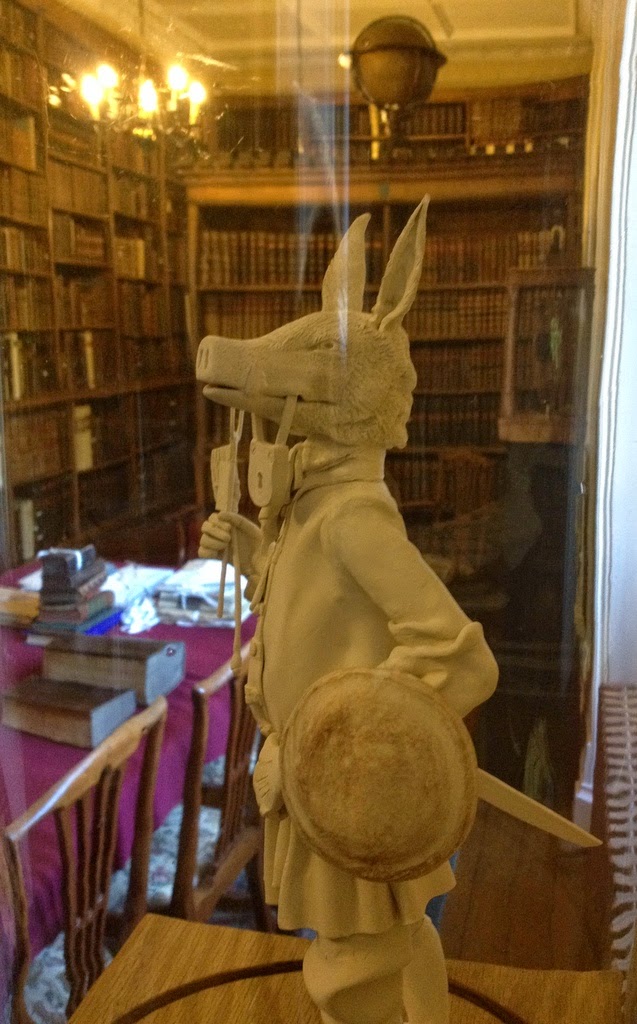
My latest work in progress is a figure of Jeanne Baret, who was a French
lady born in 1740. She was born into a very poor family of farming
labourers, but in her lifetime she traveled the world, and became the
first lady on record to circumnavigate the globe by disguising herself
as a man on board a french naval ship. On board ship she was officially
the assistant of the scientist and aristocrat Philibert de Commerson,
who's role was to collect animals, flora and fauna which could adapt to
French colonies. Baret was discovered as a woman during the voyage,
although the stories of the discovery and its consequences vary greatly.
The images are of my piece unfired just after I finished modelling it in the studio toady. It's always tricky illustrating characters from history when there are no surviving portraits or photographs to work from. In some ways it makes things easier as I don't have to get the face to be an accurate representation. In other ways it is more difficult- having to make every decision about hair, dimensions, expression, attractiveness. As she has a remarkable and rare story that involves gender appearance/disguise I wanted my Jeanne Baret to be celebrated as and look like a woman. At the same time I wanted to illustrate how she may have been able to pass as a man on board ship. I wanted her to look intelligent and attractive without falling into cliches of what that might look like. I probably didn't achieve all these things, but that's what I had in mind.

(The information that follows below comes from an article by Glynis Ridley who has written a book about Jeanne Baret: http://www.todayifoundout.com/index.php/2013/07/the-woman-who-disguised-herself-as-a-man-and-became-the-first-woman-to-circumnavigate-the-globe/)
'Whatever the case, Baret and Commerson did not continue on with the
Etoile
after the masquerade was discovered. They disembarked at Mauritius,
much to the relief of Bougainville who did not want to deal with having a
woman illegally aboard his naval ship. The pair later travelled to
Madagascar to document plants there, discovering a plant named after
Baret—the
Baretia bonafidia. Unfortunately, the plant had already
been discovered and named by the time Commerson’s sample made it back
to Paris. Only one plant from the expedition honours Baret—the
Solanum baretiae—while over seventy species honour Commerson.

Commerson ended up dying on Mauritius, leaving Baret with a lot of
preserved plants and records and little means of returning home to
France. She found work on the island and married a French officer named
Jean Dubernat. Then, around 1775, Jeanne Baret returned to France with
her husband and plant specimens in tow. The plants were turned over to
the government, and Baret was later granted a pension for her service on
the expedition. Bougainville reportedly said her behaviour was
exemplary aboard the ship—she was modest and hard-working. The pension
honoured her great courage on the expedition, despite the fact that she
had disguised herself as a man.'